Using Township Canada for Genealogy & Historical Research
Convert historical homestead records, land grants, and census descriptions to modern GPS coordinates. Find your ancestor's land using Township Canada.
The same legal land descriptions used in an 1882 homestead grant still work today. The Dominion Land Survey grid has not changed since it was established in the 1870s, which means Township Canada can convert historical land records into modern GPS coordinates - letting you see exactly where your ancestors lived and worked.
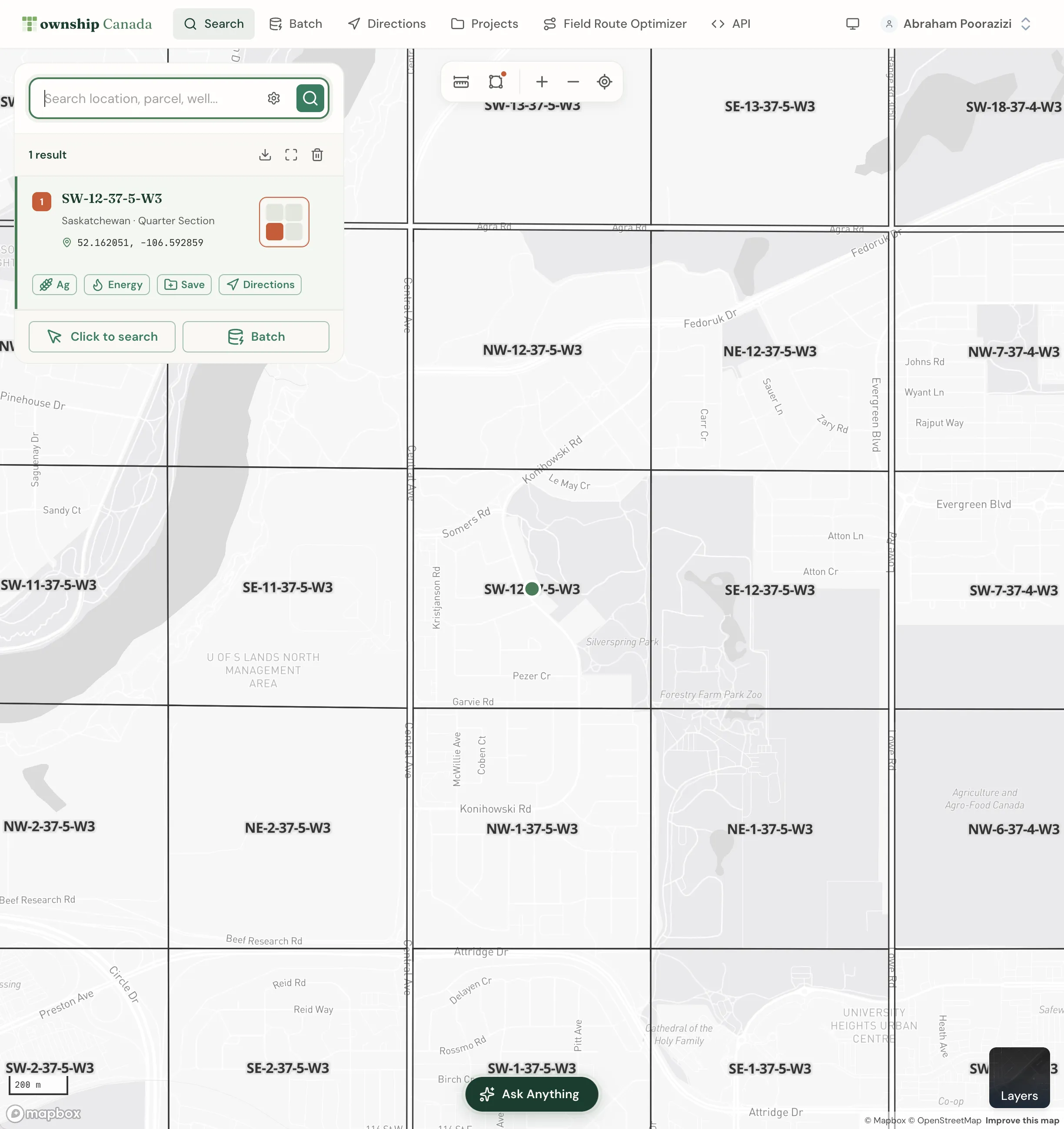
Why Township Canada works for historical research
The DLS grid is a permanent, unchanging reference system. A legal description from a Dominion Lands Act grant, a census record, or a homestead application maps to the same physical location today as it did 140 years ago.
With Township Canada, you can:
- Convert a historical legal description to GPS coordinates
- View the location on satellite imagery to see what is there now
- Get driving directions to visit the site in person
- Download the coordinates for use in other mapping tools
Where to find historical legal land descriptions
Historical land records appear in several types of documents:
- Homestead records - The Dominion Lands Act (1872–1930) granted 160-acre quarter sections to settlers who met residency and improvement requirements. Records include the legal description of the granted land.
- Census records - Canadian census forms from the late 1800s and early 1900s often note the section, township, and range where a family lived.
- Land grant documents - Crown grants and letters patent include the full legal description.
- Provincial archives - Manitoba, Saskatchewan, Alberta, and BC archives hold land records with legal descriptions.
- Library and Archives Canada - Federal homestead records are available online through the Western Land Grants database.
Translating old notation
Historical documents use different formatting than modern systems, but the underlying grid is the same. Here are common patterns:
| Historical notation | Township Canada format |
|---|---|
| Part SE section 6 township 17 Range 2 Meridian E1 | SE-6-17-2-E1 |
| Sec 5, Twp 50, Rge 1 W5M, Alberta | 5-50-1-W5 |
| NE 1/4 of Section 14, Township 32, Range 21 W4M | NE-14-32-21-W4 |
| 30-13-6E Manitoba | 30-13-6-E1 |
Key things to know:
- "E1" means East of the 1st Meridian - this covers eastern Manitoba. It is a valid meridian, not a typo.
- "Part SE" or "Part NE" means a portion of the quarter section. Drop the "Part" and search the quarter section.
- "Sec", "Twp", "Rge" are abbreviations for Section, Township, Range - strip them and use the numbers.
- Leading zeros do not matter:
04-26-W2and4-26-W2are equivalent.
What a "Homestead number" is NOT
Some documents include a homestead file number (e.g., "Homestead number 27551"). This is a registry reference for the application file - it is not a legal land description and cannot be converted to coordinates.
Look for the Section-Township-Range-Meridian on the same document. That is the description Township Canada can convert.
Step-by-step example
Say you have a homestead record from 1883 that reads:
Homestead number 27551. Part SE section 6 township 17 Range 2 Meridian E1
Extract the legal description
Ignore the homestead number. The legal description is: SE section 6, Township 17, Range 2, East of 1st Meridian.
Convert to Township Canada format
SE-6-17-2-E1
Search in Township Canada
Enter SE-6-17-2-E1 in the search box. Township Canada returns the GPS coordinates and shows the location on the map.
Explore the location
Switch to satellite imagery to see what the land looks like today. Use the directions feature to plan a visit to the site.
Historical context
The Dominion Land Survey
The DLS was established by the Dominion Lands Act of 1872 to organize land distribution in western Canada. Surveyors divided the prairies into a grid of townships (6 miles square), each containing 36 sections (1 mile square). Settlers could claim a quarter section (160 acres) as a homestead by paying a $10 fee, building a dwelling, and cultivating a portion of the land within three years.
The grid extends from Manitoba through Saskatchewan and Alberta to the Peace River region of British Columbia, all referenced from principal meridians.
Why the grid still works
Unlike street addresses that change as cities grow, the DLS grid is tied to fixed geographic coordinates. Section 6, Township 17, Range 2, E1M described the same 640 acres in 1883 as it does today. Roads may have been built through it, towns may have grown nearby, but the legal boundaries remain.
Related resources
- Dominion Land Survey System Explained - full guide to how the DLS works
- What is LSD? - understanding Legal Subdivisions
- Input Format Reference - format guide for all survey systems
- Coverage & Limitations - which provinces are supported
- Library and Archives Canada - Western Land Grants - searchable federal homestead records
Related Guides
AI Assistant - Ask Questions About Legal Land Descriptions
Use Township Canada's AI Assistant to convert legal land descriptions, get directions, validate formats, ask about a parcel's wells, soil, crops, and flood history, and learn about DLS, NTS, and Geographic Township systems through natural conversation.
Batch Convert Legal Land Descriptions - 5,000+ Records
Convert thousands of legal land descriptions to GPS coordinates and vice versa in seconds. Export to CSV, KML, Shapefile, DXF, or GeoJSON. Perfect for oil & gas, real estate, GIS, and agriculture.
Township Canada in ChatGPT and Claude
Add the published Township Canada community connector in Claude, connect ChatGPT over MCP, and use the plugin to convert land descriptions and read parcel reports.