Export to PDF, CSV, KML, Shapefile, GeoJSON, and DXF
Download search results, batch conversions, and saved projects in multiple formats. Compatible with Excel, Google Earth, ArcGIS, QGIS, and CAD software.
Township Canada supports multiple export formats for search results, batch conversions, and project data. Export to the format that works best with your workflow, from spreadsheets to professional GIS software.
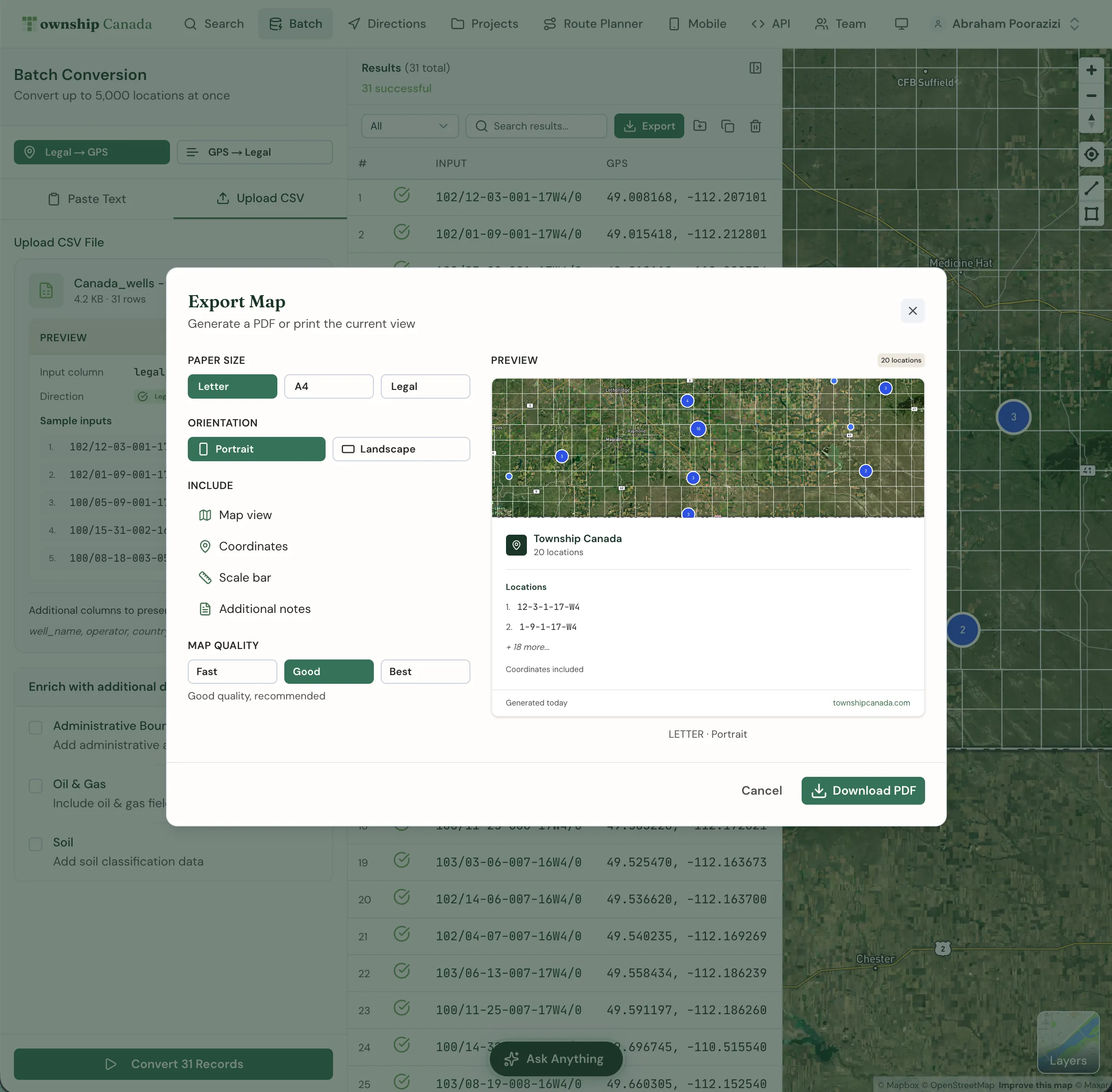
Export availability by plan
Export formats vary by subscription plan:
| Format | Starter | Pro | Business |
|---|---|---|---|
| - | Yes | Yes | |
| CSV | - | - | Yes |
| KML | - | - | Yes |
| Shapefile | - | - | Yes |
| GeoJSON | - | - | Yes |
| DXF | - | - | Yes |
Downloading search results
Export search results from the left panel:
- Perform one or more searches
- Click the Download button at the top of the results list
- Select your preferred format from the dropdown
- The file downloads to your device
Search exports include the legal land description, coordinates, province, and any additional metadata for each result.
Downloading batch conversion results
Export batch conversion results after processing:
- Complete a batch conversion
- Click the Download dropdown above the results table
- Select your preferred format
- The file downloads with all conversion results and enrichment data
Batch exports include all columns from your conversion, including any enrichment data (administrative boundaries, oil & gas fields, soil characteristics).
Downloading project data
Export saved locations from your Projects:
- Open the project you want to export
- Click the Download button in the project header
- Select your preferred format
Project exports include location details, notes, categories, and coordinates.
Supported export formats
A formatted report containing all location data with coordinates, legal descriptions, and any notes. Ideal for sharing with colleagues or clients who don't need to import the data into other software.
Best for: Printing, sharing, presentations, record keeping
CSV (Comma-Separated Values)
Plain text format with one row per location. Opens directly in Excel, Google Sheets, and other spreadsheet applications.
Best for: Excel analysis, database import, data sharing
Columns include:
- Legal land description
- Latitude and longitude
- Province/territory
- Enrichment data (if included)
KML (Keyhole Markup Language)
Geographic data format used by Google Earth and other mapping applications. Displays your locations as placemarks on a 3D globe.
Best for: Google Earth visualization, field presentations, route planning
Shapefile
Industry-standard GIS format compatible with ArcGIS, QGIS, and other professional GIS software. Includes both point and polygon geometries.
Best for: GIS analysis, spatial data integration, professional mapping
Includes:
- .shp (geometry)
- .shx (index)
- .dbf (attributes)
- .prj (projection)
GeoJSON
Web-friendly geographic data format. Widely supported by web mapping libraries like Leaflet, Mapbox GL JS, and OpenLayers.
Best for: Web development, API integration, modern GIS tools
DXF (Drawing Exchange Format)
CAD format compatible with AutoCAD, and other drafting software. Exports location points for integration with engineering drawings.
Best for: CAD integration, engineering drawings, construction planning
Export tips
Large exports
For exports with thousands of locations, the download may take a few moments to generate. The file downloads automatically when ready.
Coordinate systems
All exports use WGS84 (EPSG:4326) coordinate reference system, the standard for GPS coordinates. This is compatible with most mapping software.
Opening Shapefiles
Shapefiles download as a ZIP archive containing multiple files. Extract all files to the same folder before opening in your GIS software.
Importing to Excel
CSV files open directly in Excel. For best results, use File > Open and select the CSV file rather than double-clicking, which allows you to specify column formats.
Related guides
- Search & Convert Locations - Find locations to export
- Batch Conversion - Convert and export bulk data
- Projects - Organize and export saved locations
Related Guides
AI Assistant - Ask Questions About Legal Land Descriptions
Use Township Canada's AI Assistant to convert legal land descriptions, get directions, validate formats, ask about a parcel's wells, soil, crops, and flood history, and learn about DLS, NTS, and Geographic Township systems through natural conversation.
Batch Convert Legal Land Descriptions - 5,000+ Records
Convert thousands of legal land descriptions to GPS coordinates and vice versa in seconds. Export to CSV, KML, Shapefile, DXF, or GeoJSON. Perfect for oil & gas, real estate, GIS, and agriculture.
Township Canada in ChatGPT and Claude
Add the published Township Canada community connector in Claude, connect ChatGPT over MCP, and use the plugin to convert land descriptions and read parcel reports.