CLI Land Capability: the National Agricultural Baseline
The Canada Land Inventory classifies every cultivable parcel into seven capability classes. Township Canada uses it as the 30% capability component of the Productivity Score.
What it is
The Canada Land Inventory (CLI) Land Capability for Agriculture classifies every cultivable parcel in Canada into one of seven classes (1 is the best, 7 has no capability) plus Class O for organic soils and Class 8 for non-arable land. Mapped at 1:50,000, CLI has been the national agricultural-capability baseline used in valuation and policy since the 1960s.
What it carries
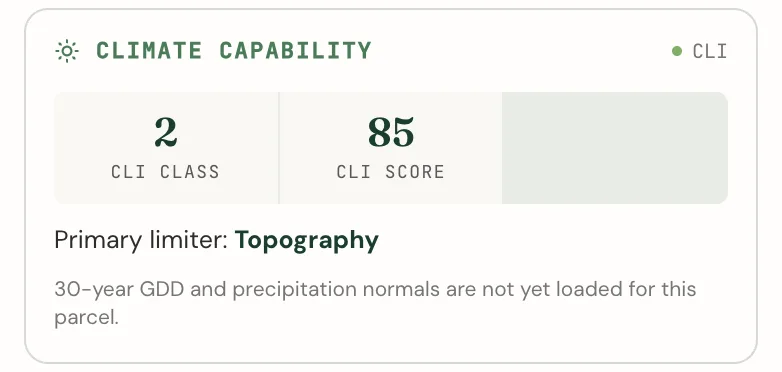
Each parcel carries its CLI class and a single-letter limiter code - for example M for moisture or T for topography - that explains why the parcel is rated where it is. Township Canada inverts and normalizes the class to a 0-100 score: Class 1 maps to 100, Class 4 to roughly 57, Class 7 to 14.
Coverage and refresh
CLI is a static reference layer: the class boundaries reflect the original 1960s-to-1980s mapping and are revised only occasionally. It is national in coverage. Because it is decades old, we treat it as one input among four, not the last word - field-level appraisal still requires on-the-ground verification.
Contains information licensed under the Open Government Licence - Canada. Source: Agriculture and Agri-Food Canada - Canada Land Inventory.
How Township Canada shows it
CLI is the capability component (30% weight) of the composite Productivity Score. The class and its limiter are shown on the Agriculture tab of the parcel report for context, but the limiter does not change the score on its own.
Related
Related Articles
AAFC Annual Crop Inventory: Five-Year Crop History
The AAFC Annual Crop Inventory is the satellite-derived crop map of Canada. Township Canada turns it into a five-year rotation, dominant crop, and diversity index per quarter section.
AAFC Land Use v5: Dominant Land-Use Class per Quarter Section
AAFC's National Land Use product classifies every quarter section as cropland, grassland, forest, or settlement, with an IPCC group. Township Canada carries it per quarter section.
AGRASID 4.1 and LSRS: Alberta Soil and the Productivity Score
AGRASID 4.1 is Alberta's soil information database and the source of the LSRS productivity score. Township Canada carries soil detail and the 0-100 score per quarter section.