
By Township Canada
DLS Tools for Alberta Well Closure Professionals
How well closure companies use DLS conversion tools to locate closure sites, batch-process AER filings, and dispatch field crews across Alberta's well inventory.
A closure company in Red Deer picks up a contract to abandon and remediate 40 wells from an inactive licensee. The acquisition package arrives as a spreadsheet: 40 rows of UWIs, each encoding a legal land description. Before anyone drives to a site, the project coordinator needs GPS coordinates for every well, a map showing the geographic spread, and a route plan for the field crews who will perform the downhole work.
Converting 40 LSDs by hand takes most of a morning. It also carries risk: a transposed range number or a wrong meridian puts coordinates kilometres from the actual well. In an industry where the AER tracks every closure against a specific LSD, that kind of error creates delays in regulatory filings and wasted days in the field.
This is the daily reality for Alberta's well closure sector, an industry where every job starts with a legal land description and every mistake in conversion has a cost.
Alberta's Closure Mandate and the Scale of the Problem
The AER has sharply increased mandated industry-wide closure spending in recent years. Alberta has a large inventory of wells on record, and the Orphan Well Association manages thousands of additional sites where the original licensee no longer exists. Every one of those wells is identified by a DLS location: Legal Subdivision, Section, Township, Range, and Meridian.
For closure companies, the DLS system isn't optional. It's the addressing system for every well licence, every Directive 013 abandonment application, every environmental site assessment, and every reclamation certificate. The volume of DLS-to-GPS conversions happening across the industry every day is large, and it's growing as closure obligations increase.
Where DLS Conversion Fits in the Closure Workflow
Inventory Verification
When a closure company acquires a portfolio of wells, the first step is verifying that every LSD in the acquisition data resolves to a valid location. A UWI like 100/10-33-037-04W5/00 encodes an LSD, 10-33-037-04W5, that should place the well near Sundre. If the data has a typo (the township reads 037 when it should be 038), the coordinates point to a different section. Catching that before it enters the project database prevents downstream errors in work orders and AER filings.
Upload the full UWI list to a batch converter and the output flags any entries that don't resolve to a valid parcel. The validation step that used to happen manually, one LSD at a time, takes seconds for the entire inventory.
Field Crew Dispatch
Closure work is physical. Abandonment rigs, environmental sampling crews, and reclamation teams all need to drive to specific well sites on rural range roads. The work order lists the site as an LSD; the truck's GPS needs latitude and longitude.
A wrong meridian is the most expensive conversion error in the field. LSD 06-18-039-05W5 is near Nordegg in west-central Alberta. The same LSD at W4 is near Consort, roughly 250 kilometres east. A rig crew dispatched to the wrong meridian loses a full day of mobilization time, plus the fuel, accommodation, and scheduling costs of rerouting.
For multi-site campaigns, a route planner that accepts LSDs directly avoids the manual step of converting each site individually. Enter the closure site LSDs, get an optimized driving sequence with turn-by-turn directions on township and range roads.
Regulatory Filings
Every AER closure filing, Directive 013 for abandonment, Directive 079 for reclamation, references the well by its legal land description and includes location coordinates. The filing needs to be consistent: the LSD on the application must match the coordinates on the location map. Using the same conversion source for both the field dispatch and the regulatory submission eliminates discrepancies.
Results that export to multiple formats (CSV for the application form, KML for the location map, Shapefile for GIS analysis) mean the filing team doesn't need to re-convert or reformat location data for each document in the submission package.
Three Workflows That Save Time
1. Batch-Convert a Closure Inventory
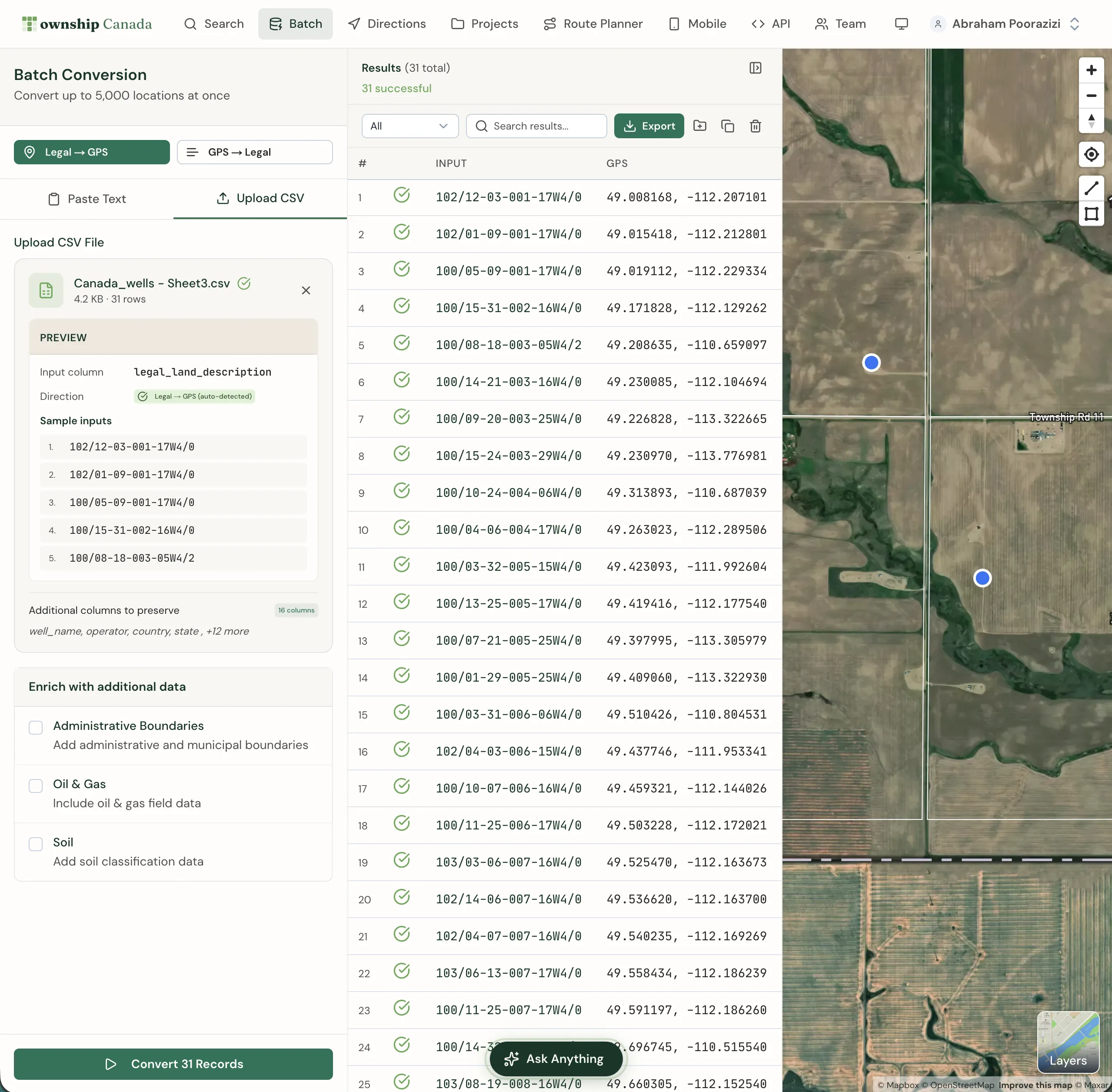
A remediation company managing 200 sites across central Alberta needs GPS coordinates for the full inventory. Upload the CSV to Township Canada's batch converter. Every row gets coordinates and validation in seconds. The output includes a downloadable CSV with lat/lng columns and a KML file that shows the entire project footprint in Google Earth.
The alternative, converting 200 LSDs one at a time, takes a full working day and introduces manual transcription risk at every row.
2. Plan a Multi-Site Field Day
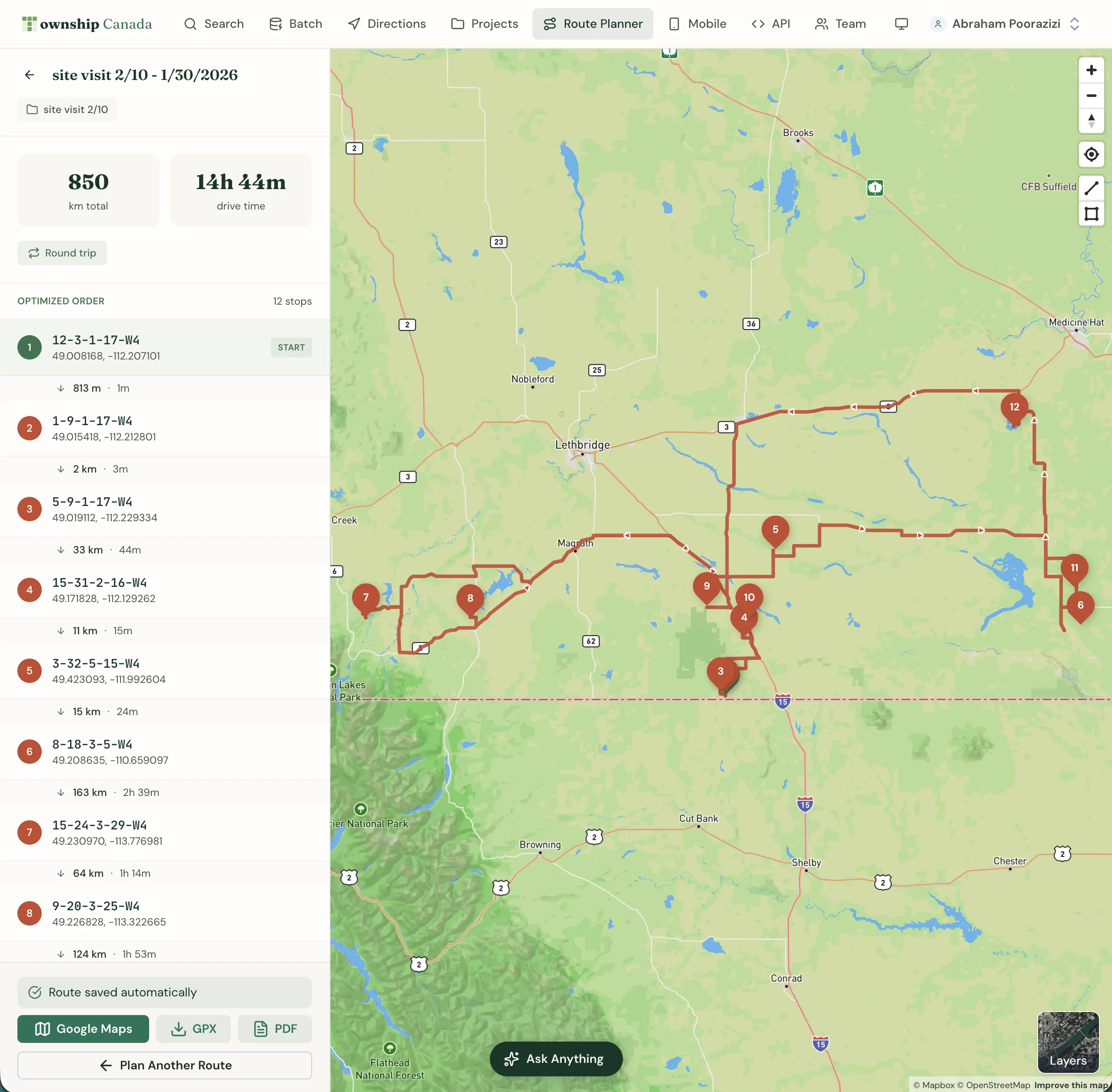
An inspector visiting eight orphan well sites across Townships 42-45, Range 2-4 W5M, enters the LSDs into the route planner. The tool converts each LSD to coordinates and calculates the most efficient driving order. Eight stops, optimized sequence, turn-by-turn directions on rural roads. What used to be 30 minutes of manual planning and route guessing takes five minutes.
3. Export for an AER Filing Package
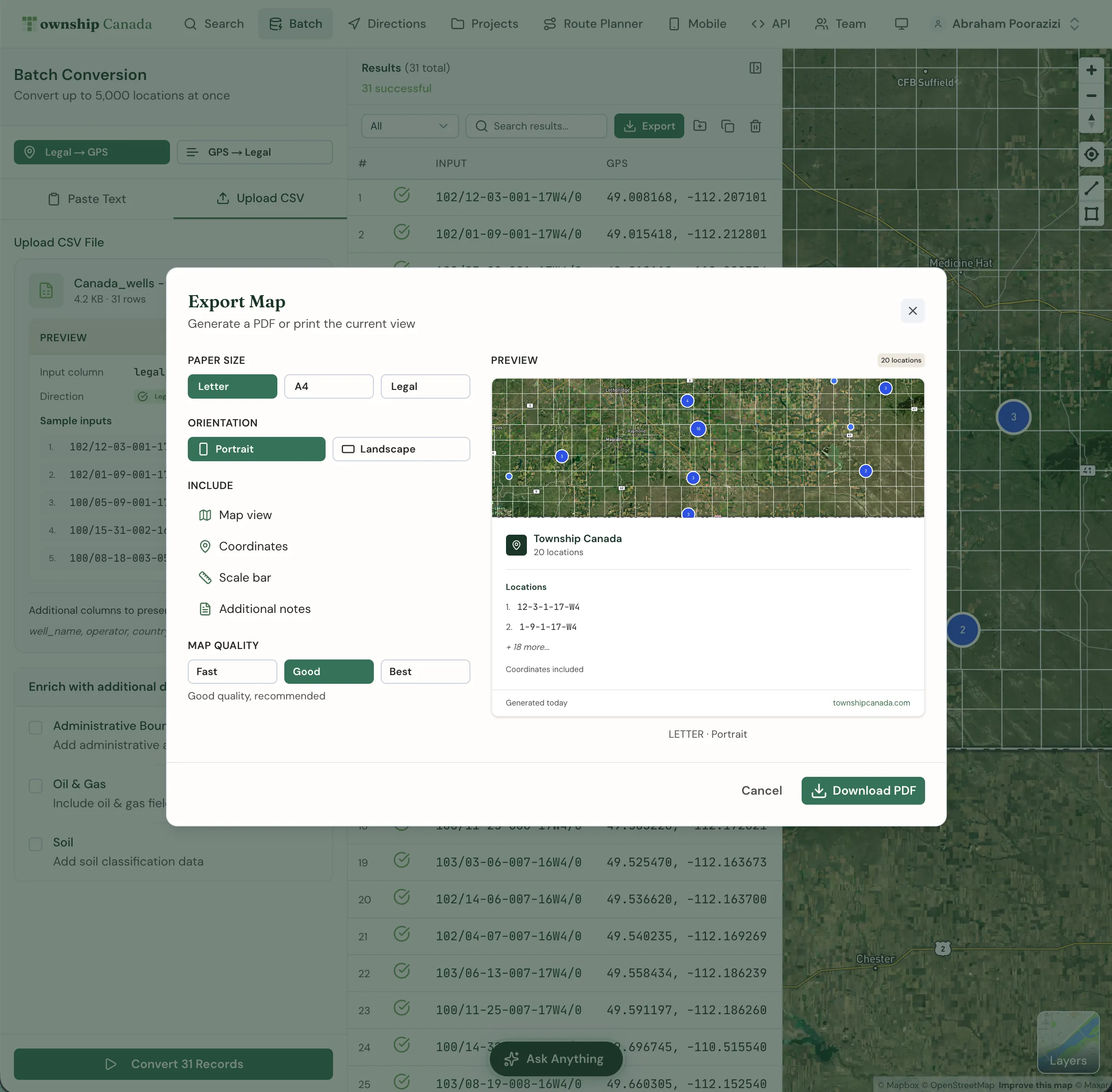
After completing downhole abandonment at LSD 14-07-040-04W5, the closure company needs to submit the completion report. The filing requires the site location in the application form (coordinates), a site map (KML), and a GIS layer for the environmental assessment (Shapefile). Convert the LSD once in Township Canada, export in all three formats, and attach them to the filing. One conversion produces every format the AER needs.
What to Look For in a DLS Tool
Closure companies deal with DLS data at a scale that makes manual conversion impractical. The right tool needs to handle:
- Batch processing: Hundreds of LSDs at once, not one at a time
- Validation: Flag entries that don't resolve - wrong meridians, out-of-range townships, missing data
- Multiple export formats: CSV, KML, Shapefile, GeoJSON, DXF, PDF - the formats that AER submissions, GIS platforms, and CAD software expect
- Route planning: Convert LSDs to an optimized driving sequence for field crews
- Team access: Multiple users on the same account with shared project data
Township Canada's Business plan covers all of these. Individual consultants doing occasional lookups can start with free lookups, no credit card required. For teams processing closure inventories, running field operations, or filing AER applications, the Business plan fits the workflow.
If your closure company is converting LSDs manually, try the batch converter with your next project list. The time difference is measurable from the first upload.