FPS Grid Converter - NWT, Nunavut, and Yukon Land Descriptions
Convert Federal Permit System (FPS) grid references for NWT, Nunavut, and Yukon to GPS coordinates. Step-by-step guide with format examples and a live FPS converter.
FPS Grid Converter - NWT, Nunavut, and Yukon Land Descriptions
Federal Permit System (FPS) grid references describe oil and gas permit areas across Canada's northern territories - the Northwest Territories, Nunavut, Yukon, and federal offshore. If you have a permit document referencing a grid like 48 60-20 N 100-30 W and need to find it on a map, this is how to do it.
Township Canada's FPS grid converter handles all three FPS formats and plots them directly on a map with GPS coordinates.
What You'll Learn
- How the FPS grid system is structured
- The three reference formats you'll encounter in permit documents
- Step-by-step instructions for converting any FPS reference to GPS
- Common input errors that produce wrong results
What Is the Federal Permit System Grid? {#what-is-fps}
The FPS is the land description system Canada's federal government uses to administer oil and gas exploration rights north of 60° and in federal offshore areas. Unlike the Dominion Land Survey (which covers the Prairie provinces), FPS grids are not based on township-and-range geometry. Each grid is identified by the geographic coordinates of its northeast corner.
The grid at 60-20 N 100-30 W marks a block in Nunavut whose northeast corner sits at 60°20′N, 100°30′W. The block extends 10 minutes south in latitude and 15 minutes west in longitude - roughly 600 to 800 square kilometres depending on latitude. Above 70°N, the longitudinal width expands to 30 minutes.
Within each grid, numbered sections (1–99) subdivide the area, and each section breaks further into units lettered A through P.
For a full explanation of FPS structure and its relationship to NTS, see The Federal Permit System (FPS) Explained.
The Three FPS Formats {#fps-formats}
FPS descriptions appear at three levels of precision. Township Canada's FPS grid converter recognizes all three.
Format 1 - Grid Only
60-20 N 100-30 W
Identifies the full grid block. Use this when you need to confirm the general area covered by a permit.
Format 2 - Section + Grid
48 60-20 N 100-30 W
Section 48 within the grid. This is the most common format in exploration permit documents and covers a fraction of the full grid block.
Format 3 - Unit + Section + Grid
F 48 60-20 N 100-30 W
Unit F of Section 48 within the grid. This is the most precise level - comparable to a quarter section in resolution. Unit letters run A through P.
Step-by-Step: Convert an FPS Reference to GPS {#conversion-steps}
- Identify the format - determine whether you have a grid, section+grid, or unit+section+grid reference from your permit document.
- Open Township Canada - go to townshipcanada.com/app.
- Enter the FPS reference in the search bar - type it exactly as it appears. For the Nunavut example above:
48 60-20 N 100-30 W. The converter returns a map pin at the centroid and shows the bounding polygon. - Read the coordinates - lat/lng appears in the result panel. Copy or export as needed.
- Export for GIS - on Business tier, export the result as KML, GeoJSON, or Shapefile for use in ArcGIS or QGIS.
For a batch of permit references, upload a CSV to the Business tier batch converter. See Batch Convert Legal Land Descriptions for setup details.
Example: Nunavut Exploration Permit {#example}
A land technician reviewing a historical permit finds F 48 60-20 N 100-30 W. To locate it:
- Search
F 48 60-20 N 100-30 Win Township Canada - The result pins Unit F of Section 48, grid northeast corner 60°20′N, 100°30′W - western Nunavut, southwest of Baker Lake
- Centroid returns approximately 60.10°N, 100.55°W
With the GPS location confirmed, the technician can pull satellite imagery, check for nearby well records, and verify proximity to other licensed areas - all in one view.
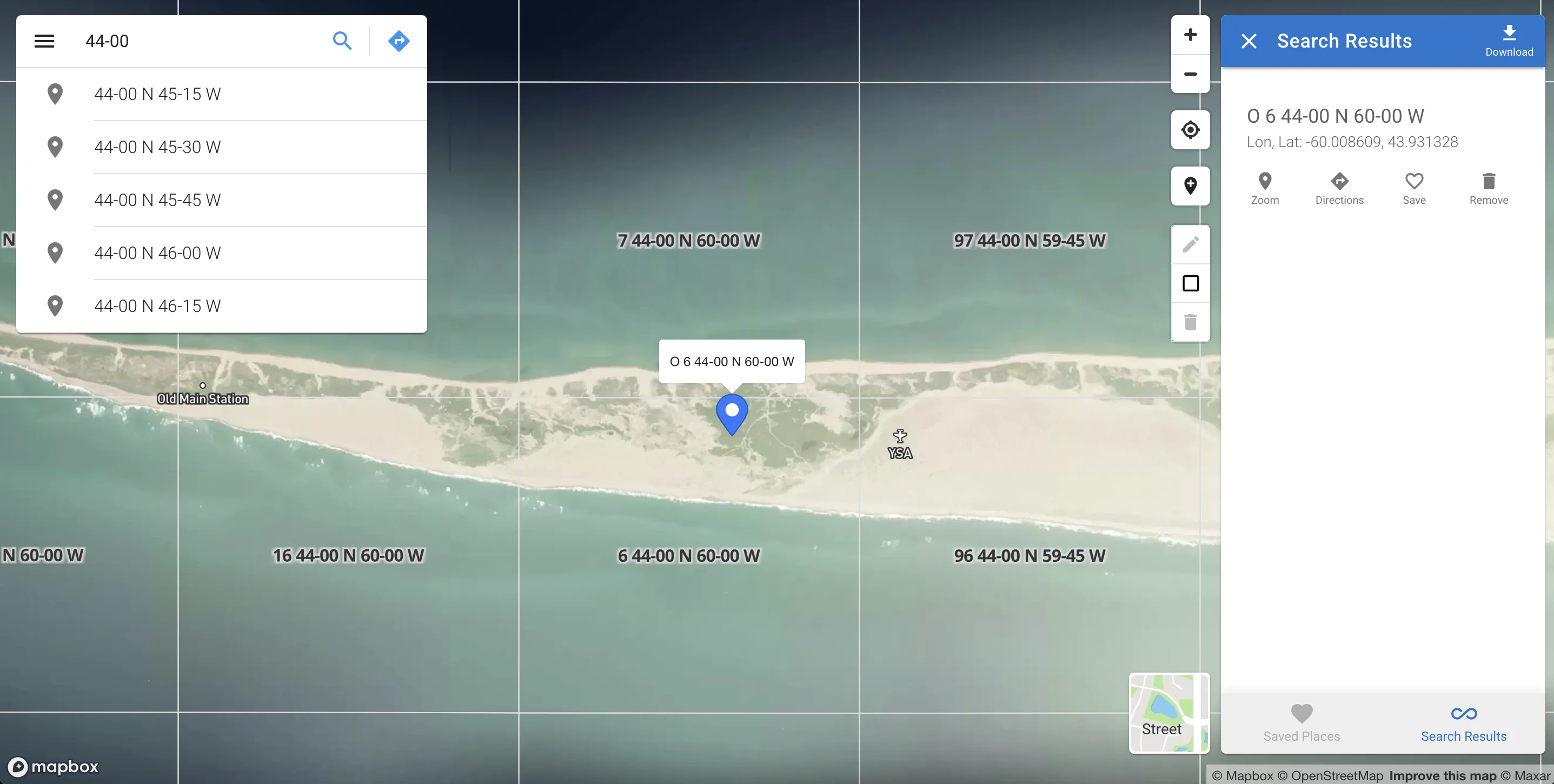
Township Canada added FPS grid support in 2023 and brought it into the unified search panel in 2026 as an opt-in source alongside DLS and NTS. For the original integration, see The Federal Permit System grids are now available in Township Canada; for the unified-search rollout and the new survey system tag on every result, see Federal Permit System Grid Lookup in Canada: Search FPS, DLS, and NTS in One Place; and for the independent Locations and FPS source toggles that enable an FPS-only search mode for frontier and offshore work, see Search Source Toggles: Turn Locations and FPS On or Off Independently in Township Canada.
Common Mistakes {#common-mistakes}
Using decimal degrees instead of degrees-minutes notation: FPS grids are defined by degrees and minutes (60-20 N, not 60.33 N). Entering decimal coordinates will not match FPS grid boundaries.
Confusing FPS section numbers with NTS block numbers: FPS section numbers (1–99) are assigned within each FPS grid and do not correspond to NTS block numbering. Substituting one for the other in a permit reference will point to the wrong location.
Omitting the unit letter: A unit+section+grid reference requires the letter prefix (F 48 60-20 N 100-30 W). Dropping it returns the full section rather than the specific unit.
Missing jurisdiction context: A GPS location in the Beaufort Sea area may fall under territorial Crown land (CIRNAC), federal offshore (Canada Energy Regulator), or an area subject to land claims agreements. Township Canada returns the coordinates - the regulatory determination requires checking the permit registry. See Legal Land Descriptions for Oil and Gas for context on filing workflows.
For the NTS tools that underpin FPS geography, see NTS to GPS Converter.
Try the FPS Grid Converter
Township Canada handles all three FPS formats alongside DLS, NTS, LSD, and every other Canadian survey system - no spreadsheet lookups, no manual coordinate calculation.
Convert F 48 60-20 N 100-30 W →
Starter plan includes 100 searches per month. Business tier adds batch conversion for processing permit lists in bulk.
Related Articles
Batch Convert Legal Land Descriptions - Process Thousands of LLDs at Once
Convert hundreds or thousands of legal land descriptions to GPS coordinates at once. Upload a CSV and get results in seconds.
Legal Land Descriptions for Oil and Gas - DLS and LSD Conversion Guide
How oil and gas professionals convert DLS and LSD legal land descriptions to GPS coordinates for well licences, pipeline routes, and AER filings.
NTS to GPS Converter - Convert NTS Grid References to Coordinates
Convert NTS (National Topographic System) grid references to GPS coordinates. Step-by-step guide for British Columbia land descriptions with examples.