By Township Canada
How Insurance Companies Use Legal Land Descriptions
Property identification for claims, hail and flood damage assessment by LSD, batch processing policy portfolios, and regulatory compliance - how insurers use Township Canada.
In late June 2023, a hailstorm swept through a 20-township corridor in southern Alberta - roughly 460,000 acres of farmland, acreages, and rural properties. Within 48 hours, an insurance company's claims team was staring at a spreadsheet of 300 insured properties, each identified by a legal land description: LSD 06-32-048-07W5, SE 14-038-22W4M, NW 02-045-01W5. Their policy management system didn't store GPS coordinates. It stored addresses in the format that rural Alberta has always used - the Dominion Land Survey.
That's when the gap between policy records and field operations becomes very expensive.
Why Rural Insurance Runs on Legal Land Descriptions
Rural property in western Canada has always been identified by legal land descriptions, not civic addresses. A farmstead 30 kilometres from the nearest town doesn't have a street number. Its legal identity is a quarter section or LSD on the DLS grid - and that's exactly how it appears on title, on property tax records, on crop insurance applications, and on insurance policies.
This applies across most rural insurance lines:
- Property insurance for rural structures - homes, shops, grain bins, barns - is underwritten against the legal land description on title. The insured location is an LSD or quarter section, not a GPS coordinate.
- Crop insurance policies administered through AFSC (Alberta) or SCIC (Saskatchewan) reference individual quarter sections. A producer insuring a 5,000-acre operation may have 30 or more quarter sections listed on a single policy.
- Hail and multi-peril crop insurance is assessed at the township or quarter section level. A hail adjuster's zone map is organized by townships - the same 6×6 section grids that define the DLS system.
- Acreage and hobby farm policies in rural Alberta and Saskatchewan are typically tied to the legal land description recorded at land titles.
When a claim comes in, the address is an LSD. When adjusters are dispatched, they need GPS coordinates to navigate. When regulators ask for a geographic summary of affected properties after a weather event, the data has to be organized by area. The legal land description is the thread that connects all of it - but only if your team can work with it efficiently.
The Pain Points After a Weather Event
A hailstorm, flood, or wildfire creates a time-sensitive workflow. Adjusters need to be in the field fast. Properties need to be triaged by severity. Reports need to go to reinsurers and regulators within specific timeframes.
Here's where the friction builds:
After a storm covers a defined geographic corridor, the claims team needs to know which insured properties fall within the affected area. If policies are stored by LSD, they can't simply overlay a storm path on a GPS map - they first need to convert hundreds of legal land descriptions to coordinates and plot them. Doing that manually, one LSD at a time, for 300 properties takes most of a day.
Adjusters in the field have a list of properties to inspect, each with an LSD. Without GPS coordinates, they're navigating by section road logic - fine for experienced rural drivers, time-consuming for anyone else, and a real problem when a storm has washed out section roads and the normal route no longer applies.
Regulatory reporting after a large weather event typically requires a geographic summary: total claims by township, or a map showing affected properties. Converting LSDs to coordinates is the prerequisite for generating that map.
Three Workflows That Address the Gap
1. Post-Storm Property Identification
An insurance company receives storm path data from their weather service - a polygon covering a 20-township swath of southern Alberta. The claims team exports all rural policies in the affected region from their policy management system. The output is a CSV with a column of legal land descriptions.
They upload that CSV to Township Canada's batch conversion tool (a Business plan feature). Within seconds, every LSD in the file has a GPS coordinate pair attached. The team imports the enriched CSV into their GIS or mapping tool, overlays the storm path polygon, and immediately sees which insured properties fall inside the affected zone.
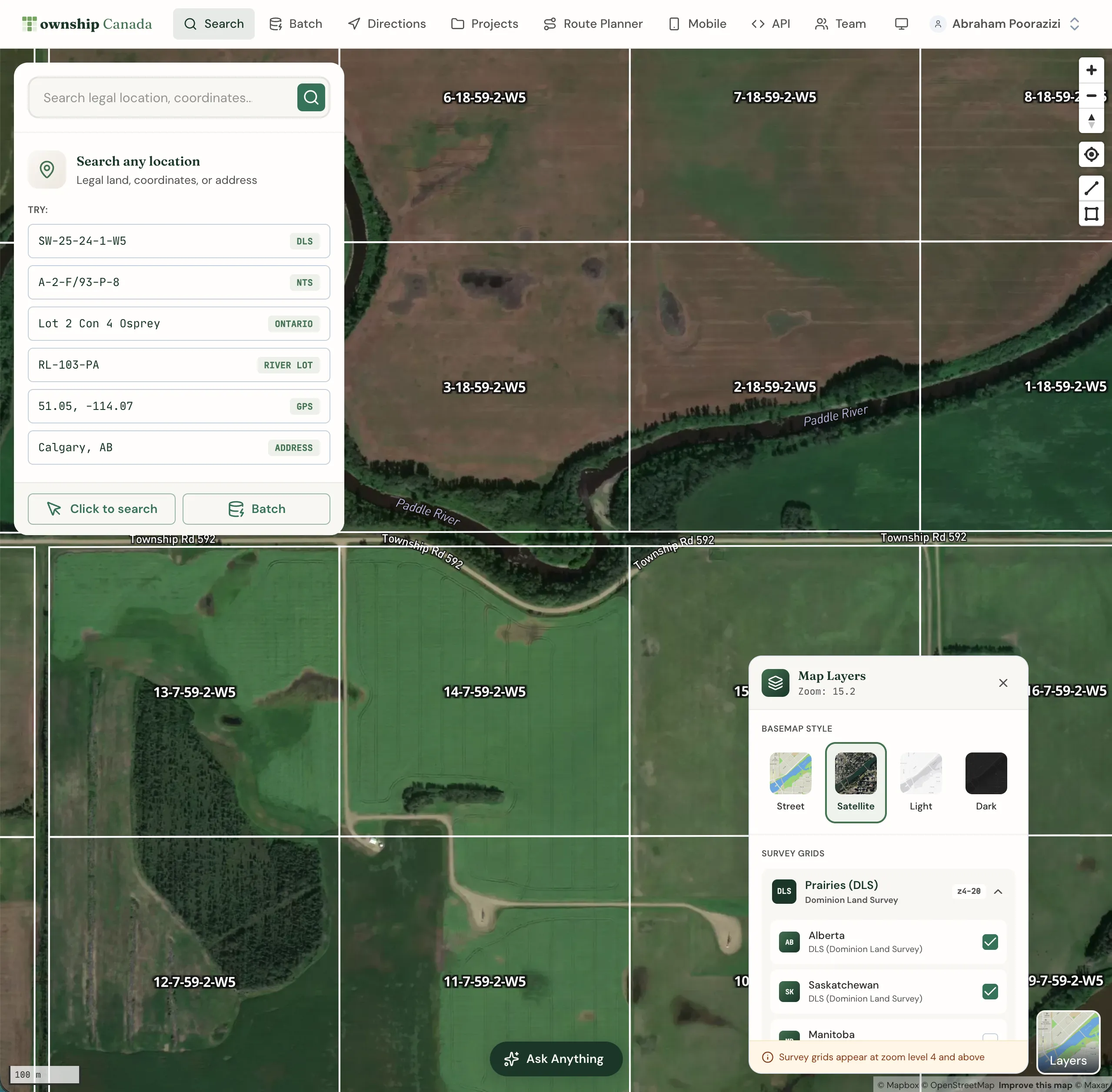
Instead of a day of manual lookup, the triage is done before lunch.
For a practical walkthrough of converting LSD addresses to GPS coordinates, see the LSD to lat/long conversion guide.
2. Field Adjuster Dispatch
An adjuster has 12 property inspections scheduled for the day. The dispatch sheet lists each property by its legal land description: NE 05-041-06W5, SW 22-040-06W5, LSD 11-17-041-05W5, and so on - scattered across two townships in the Ponoka area.
Before heading out, the adjuster enters each LSD into Township Canada's route planner (available on Pro and Business plans). The tool converts each LSD to GPS and calculates the most efficient driving order given the road network in the area. What would otherwise require manually looking up each address and piecing together a route on a paper map - or worse, driving the properties in the order they appear on the sheet - becomes a single step. Each optimization supports up to 12 stops; larger dispatch lists can be split across two routes.
Rural section roads run in a predictable grid, but the order in which claims appear on a dispatch sheet rarely matches the most efficient driving sequence. An optimized route for a day of rural properties can cut an hour or more of drive time in a single day.
3. Portfolio Risk Mapping
An insurance company wants to understand its geographic concentration risk for rural Alberta - specifically, how many insured properties fall within high-hail-frequency zones near Lethbridge and the southern foothills.
They export their entire rural Alberta portfolio: 2,400 policy locations, all stored as LSDs and quarter sections. Batch conversion (Business plan) takes those 2,400 descriptions and returns GPS coordinates in one pass. The resulting dataset is loaded into their GIS platform, giving the underwriting team a spatial view of the portfolio for the first time.
This kind of analysis - which used to require a specialist or an expensive data vendor - is now a standard step in the portfolio review cycle.
The Crop Insurance Connection
Alberta's Agriculture Financial Services Corporation (AFSC) and Saskatchewan's crop insurance programs tie coverage directly to legal land descriptions. AFSC's hail insurance, for example, is written against individual quarter sections. When a hail event triggers claims, adjusters assess damage parcel by parcel, and payouts are calculated at the quarter section level.
Insurance companies that co-insure or backstop crop policies deal with the same data format. A reinsurer reviewing an AFSC-sourced claim file sees quarter sections and LSDs - not civic addresses or GPS points. The conversion requirement runs all the way up the risk chain.
For more on how crop insurance uses the survey grid, see how agriculture depends on legal land descriptions.
Getting Started
If your team manages rural insurance policies in Alberta, Saskatchewan, Manitoba, or British Columbia, you're working with legal land descriptions every day. The question is whether you're converting them one at a time or in bulk.
For occasional lookups, Township Canada's converter handles any DLS format - LSD, quarter section, section, township - and returns GPS coordinates with a map view. No account required for single lookups.
For claims processing, portfolio analysis, or regular field dispatch, the batch conversion tool accepts CSV uploads and processes thousands of descriptions at once. Batch conversion and the full range of output formats - CSV, KML, and Shapefile - require a Business plan. See plans and pricing to find the right fit for your team's volume.
The hailstorm will come again next June. The properties that need assessment will still be identified by LSD. The faster your team can go from a list of legal land descriptions to a GPS-mapped claims queue, the faster adjusters reach policyholders.