Ontario Property Descriptions Explained - Lot, Concession, Township
How to read Ontario legal land descriptions from tax bills, property registries, and title searches. Convert lot-concession-township descriptions to GPS coordinates with Township Canada.
Ontario land descriptions look nothing like the ones used in Western Canada. Instead of numbered townships and ranges, Ontario uses named geographic townships divided into concessions and lots. If you have an Ontario property description and need GPS coordinates, this guide walks you through it.
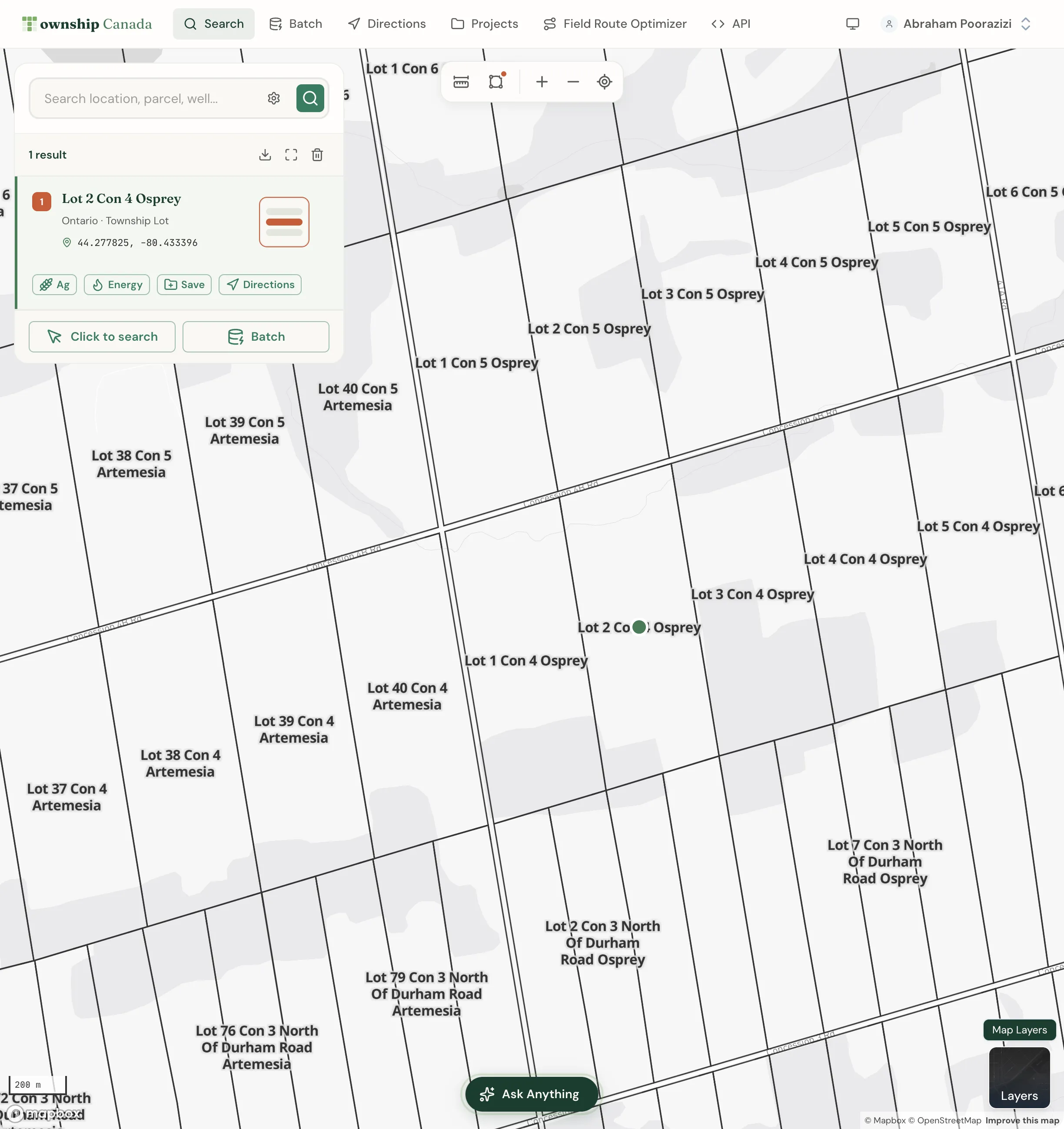
How Ontario land descriptions work
Ontario was surveyed before the western DLS grid existed, using an older British colonial model. The province is divided into geographic townships - each with a unique name like Adjala, Nipissing, or Tyendinaga.
Within each township, land is organized into:
- Concessions - long strips of land running roughly east-west, numbered from a baseline (often a lake shore, river, or road)
- Lots - individual parcels within each concession, numbered sequentially
A full Ontario legal land description has three parts:
Lot 29, Concession 10, Nipissing
In Township Canada, enter it as: Lot 29 Con 10 Nipissing
Ontario vs. the DLS (Western Canada)
| Feature | Ontario | Western DLS |
|---|---|---|
| Township names | Named (Nipissing, Glenelg) | Numbered (Township 49) |
| Internal divisions | Concessions + Lots | Sections + Quarter Sections |
| Shape | Often irregular | Uniform grid |
| Survey era | 1780s–1860s | 1870s onward |
Ontario has no meridians, no ranges, no sections, no LSDs, and no quarter sections. If someone asks you for a "section-township-range" for an Ontario address, they need the lot-concession-township instead.
Reading Ontario property documents
Tax bills
Ontario property tax bills contain a legal description that typically looks like:
LT 29 CON 10 NIPISSING
The key parts are the lot number, concession number, and township name. Everything else (roll numbers, assessment codes) is for the municipal tax system, not for location.
Important: Township Canada requires Lot spelled out - not LT. Change LT 29 to Lot 29.
Land registry entries
Full registry entries include parcel numbers, mining claims, instrument references, and other metadata:
PCL 6123 SEC NS; BROKEN LT 29 CON 10 NIPISSING BEING MINING CLAIMS PS1696 & PS1697 AS IN LP7196 EXCEPT MRO IN LT44871; NIPISSING
From this, extract only: Lot 29 Con 10 Nipissing
PCL 6123 SEC NS- parcel registry metadata, ignore itBROKEN LT- "Broken Lot" means an irregular shape (often waterfront), just use the lot numberMINING CLAIMS,AS IN LP7196- instrument references, ignore them
Title searches
Title documents may use the full form: "Lot 29, Concession 10, Township of Nipissing, District of Nipissing." The district or county name helps confirm you have the right township, but Township Canada only needs the lot, concession, and township name.
Common Ontario input mistakes
"LT" instead of "Lot"
Tax bills abbreviate "Lot" as "LT". Township Canada needs the full word.
| Wrong | Correct |
|---|---|
LT 29 CON 10 NIPISSING | Lot 29 Con 10 Nipissing |
Including registry metadata
Strip everything that is not lot, concession, or township. Parcel numbers, mining claims, instrument numbers, and PIN references are not part of the geographic description.
Missing the township name
Ontario lookups require all three components: lot, concession, and township name. Unlike the DLS where you use numbers for everything, Ontario needs the actual name - spelled correctly.
The search autocomplete can help you find the right spelling. Start typing the township name and select from the suggestions.
Concession qualifiers
Some Ontario townships have concessions qualified by geographic features. These qualifiers matter - they distinguish between different numbering systems within the same township.
Examples:
Lot 12 Con 4 North Of Durham Road GlenelgLot 5 Con 2 South Of Hurontario Street Mono
Include the full qualifier when searching.
"Broken Lot"
Some lots are labelled "Broken Lot" or "BROKEN LT" in official records. This means the lot has an irregular shape - usually because it borders a lake, river, or provincial boundary. Use the lot number normally; the "broken" label does not change the lookup.
Examples from real Ontario documents
| What you have | What to enter | Location |
|---|---|---|
| LT 29 CON 10 NIPISSING | Lot 29 Con 10 Nipissing | Nipissing District, northeastern Ontario |
| LOT 21 CONC 1 TYENDINAGA | Lot 21 Con 1 Tyendinaga | Hastings County, near Belleville |
| BROKEN LT 5 CON 3 GLENELG | Lot 5 Con 3 Glenelg | Grey County, near Durham |
| Lot 12 Con 4 North Of Durham Road Glenelg | Lot 12 Con 4 North Of Durham Road Glenelg | Grey County |
| LT 2 CON 4 OSPREY | Lot 2 Con 4 Osprey | Grey County, near Collingwood |
Converting Ontario descriptions
Collect the full description
You need three components: lot number, concession number, and geographic township name.
Enter in Township Canada
Type the description in the search box: Lot 29 Con 10 Nipissing. Use "Lot" (not "LT"), "Con" or "Concession", and the township name.
Review the result
The map shows the parcel boundary or center point. GPS coordinates appear alongside the result. Verify the location looks correct relative to roads and landmarks you recognize.
Export or navigate
Copy the coordinates, get driving directions, save to a project, or download in CSV, KML, Shapefile, or other formats.
Related guides
- Search & Convert Locations - full search guide
- Input Format Reference - formats for all survey systems
- Ontario Lot and Concession Lookup - step-by-step how-to
- Batch Conversion - convert many Ontario descriptions at once
- Coverage & Limitations - what regions are supported
Related Guides
Supported Coverage & Regional Limitations
Which provinces and territories does Township Canada cover? Understand coverage by survey system, resolution limits, and known gaps in Winnipeg and unsupported provinces.
Get Directions to Legal Land Descriptions | LSD Navigation
Get driving directions to legal land descriptions, LSDs, and quarter sections. Navigate to remote well sites, field locations, and rural properties using DLS or NTS coordinates with turn-by-turn instructions.
Dominion Land Survey (DLS) System Explained
Complete guide to the Dominion Land Survey system used in Alberta, Saskatchewan, Manitoba, and BC. Learn about townships, ranges, sections, and meridians.